
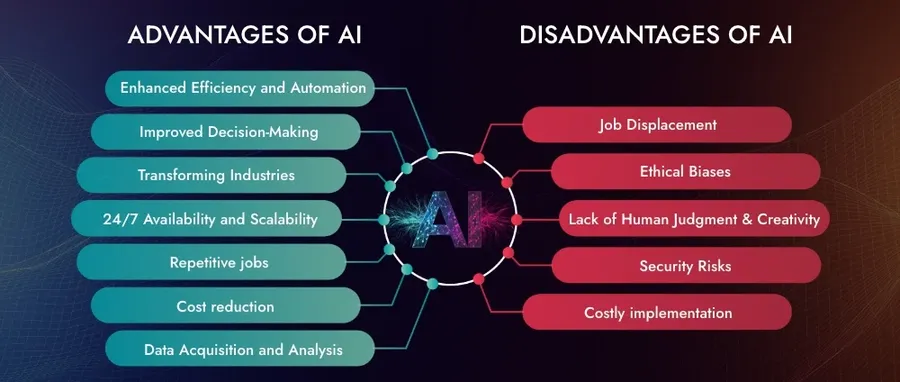
Quick Summary: Benefits vs Risks
AI can boost productivity by up to 40% in some industries and speed up breakthroughs in medicine and science. At the same time, it risks displacing millions of jobs, spreading misinformation, and raising serious safety and ethical questions. The future depends on how we manage it.
Quick Summary: Benefits and Risks of AI
Artificial intelligence brings powerful tools that can solve complex problems and improve daily life. However, rapid development also creates real challenges around jobs, fairness, security, and long-term control. Understanding both sides helps us make smarter decisions.
Major Benefits of Artificial Intelligence
AI is already delivering impressive gains. In healthcare, AI systems help detect diseases like cancer earlier with accuracy that sometimes surpasses human experts. In business, companies report productivity increases of 30-40% when using AI for routine tasks. Scientific research is accelerating – AI helped design new proteins and speed up drug discovery during the pandemic. Creative fields benefit too, with tools that assist writers, artists, and musicians in exploring new ideas faster.
Key Risks and Downsides of AI
The biggest concerns include large-scale job displacement. Estimates suggest AI could impact hundreds of millions of jobs globally, especially in repetitive or data-heavy roles. Algorithmic bias is another serious issue – systems trained on flawed data can discriminate against certain groups. Deepfakes and AI-generated misinformation threaten trust in media and elections. There are also worries about loss of privacy, autonomous weapons, and in the long term, the possibility of advanced AI systems behaving in ways humans didn’t intend.
Economic Impact on Jobs and Society
While some jobs will shrink, new roles in AI development, data labeling, ethics oversight, and AI system maintenance are emerging. History shows technology tends to create more jobs than it destroys over time, but the transition can be painful for workers in affected sectors. Societies that invest in retraining and education will likely adapt better.
Ethical and Safety Concerns
Who is responsible when an AI makes a wrong decision in healthcare or autonomous driving? How do we prevent powerful AI from being used for harmful purposes? These questions don’t have easy answers. Many experts call for stronger regulation, transparency in how models are trained, and international cooperation on safety standards.
Benefits vs Risks of AI – Summary Table
| Aspect | Benefits | Risks |
|---|---|---|
| Productivity | 30-40% gains in many sectors | Job displacement for routine tasks |
| Healthcare | Earlier disease detection | Bias in diagnostic tools |
| Information | Faster research and knowledge access | Spread of deepfakes and misinformation |
| Safety | Autonomous systems in dangerous jobs | Potential loss of human control |
A Balanced Perspective on AI
AI is neither purely good nor purely bad. Like electricity or the internet, it is a powerful technology whose impact depends on how we use it. The goal should be maximizing benefits while actively managing risks through smart regulation, ethical development, and public awareness.
What Individuals and Society Should Do
Individuals should focus on building skills that AI complements – creativity, critical thinking, emotional intelligence, and the ability to work with AI tools. Society needs thoughtful policies around education, worker support, data privacy, and AI safety research. Staying informed and participating in the conversation matters.
FAQs – Benefits and Risks of Artificial Intelligence
Will AI take away most jobs?
AI will transform many jobs, but history suggests it creates new opportunities too. The transition period will be challenging for some sectors.
Is AI dangerous?
Current AI systems are tools with limitations. Future advanced AI could pose bigger risks if not developed carefully, which is why safety research is important.
Should we slow down AI development?
Many experts argue for responsible acceleration with strong safety measures rather than slowing down completely, to ensure benefits are realized while managing risks.
Conclusion: Navigating the AI Era Wisely
Artificial intelligence offers incredible potential to solve problems and improve lives, but it also comes with real challenges we must address thoughtfully. By understanding both the benefits and risks, we can work toward a future where AI serves humanity rather than the other way around.
To dive deeper, explore how to start learning artificial intelligence from scratch or practical uses of AI in everyday life.
Data Sources & References
Insights drawn from reports by McKinsey, Goldman Sachs, World Economic Forum, and expert analyses on AI capabilities and risks as of 2026.