
Why Gravity is the Only Resistance Tool You Need in 2026
The fitness industry wants you to believe you need expensive machines to build visual muscle. Qualitative exercise physiology studies prove that your muscle fibers cannot tell the difference between a metal barbell and your own body mass. If the tension is high enough and you train close to mechanical failure, your body will adapt by growing stronger. A no-equipment routine eliminates barriers of commute time, membership fees, and visual clutter.
Quick Checklist: Preparing Your Home Workout Space
If you want to run the best full-body home workout routine with no equipment, you must prepare your environment to prevent visual procrastination traps.
- Clear a 2x2 meter visual space: Ensure you can stretch your arms out without hitting furniture. Compare this to decluttering your desk to beat study procrastination parameters.
- Drink 500ml of water before starting: Hydration drives muscular visual endurance.
- Warm up for 5 minutes: Arm circles, leg swings, and dynamic visual mobility.
- Set a digital countdown timer: Keeps rest periods honest and prevents time leaks. Compare this to making a practical weekly timetable.
Step 1: Mastering Primal Movement Vectors
A balanced full-body routine requires hitting the four functional movement parameters. If you only do push-ups, you create visual muscle imbalances.
- The Push (Chest/Triceps): Standard push-ups, pike push-ups for shoulders.
- The Pull (Back/Biceps): Floor towel pulls, superman holds, table pull-ups. Contrast these pulls with active recall mental retrieval pulls.
- The Squat (Quads/Glutes): Standard squats, reverse lunges, wall sits. Track these parameters like auditing subterranean fault shifts.
- The Hinge (Hamstrings/Lower Back): Single-leg glute bridges, good mornings.
Step 2: The 30-Minute Bodyweight Routine
Execute this circuit 3 to 4 times. Rest 60 seconds between exercises and 2 minutes between whole circuits.
- Lower Body Burn: 15-20 Prisoner Squats (hands behind head).
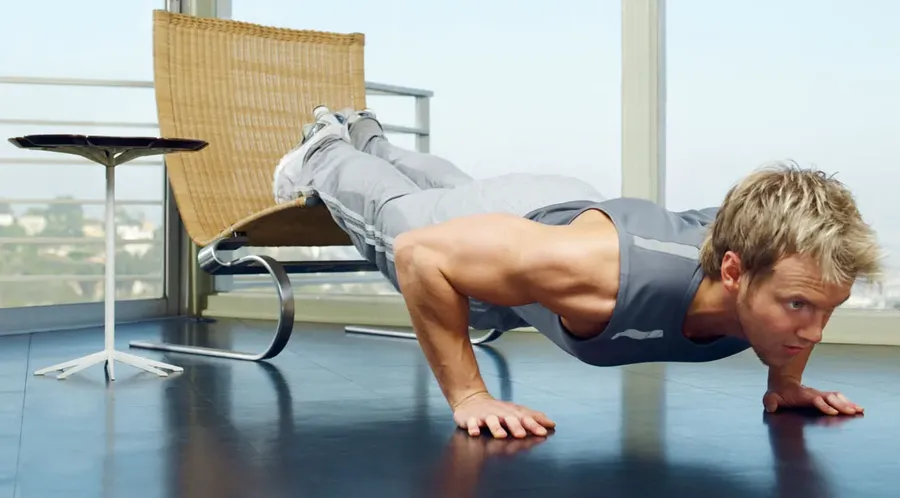
- Upper Horizontal Push: 10-15 Standard Push-ups (drop to knees if needed).
- Posterior Chain Hinge: 12-15 Glute Bridges (squeeze glutes at the top).
- Upper Vertical Push: 8-12 Pike Push-ups (head moves forward between hands).
- Core Parameter: 30-45 second Plank (maintain rigid hollow body). Compare this static tension to reading weather telemetry data.
Visual Checklist of Bodyweight Exercise Progressions
Let us audit the reading parameters. Below is a standard table demonstrating how to scale no-equipment exercises up or down based on your visual strength.
| Muscle Tier | Level 1 (Beginner) | Level 2 (Advanced) |
|---|---|---|
| Chest / Front Delts | Wall or Incline Push-ups | Decline Push-ups |
| Quads / Legs | Standard Air Squats | Pistol (Single-Leg) Squat |
| Core / Abs | Standard Knee Planks | V-Ups or Hollow Body Rock |
Frequently Asked Questions
Can you build muscle with no equipment home workouts?
Yes. Muscle hypertrophy occurs via mechanical tension. By doing hard bodyweight progressions (like decline push-ups or pistol squats) and training close to failure, you can stimulate muscle growth without weights.
How many times a week should I do a full-body home workout?
Aim for 3 to 4 times a week on non-consecutive days (e.g., Monday, Wednesday, Friday). This frequency gives your central nervous system and muscle fibers 48 hours to recover.
What is the best bodyweight exercise for the back with no equipment?
The floor pull-up (sliding on a towel), superman holds, or inverted rows underneath a sturdy table are the best ways to target the lats and rhomboids without pull-up bars.
Conclusion
Mastering the best full-body home workout routine with no equipment gives you total autonomy over your health. By utilizing visual reading tables, equalizing push-pull ratios, and tracking progression metrics, you override visual fitness barriers in 2026. Put on your workout clothes right now and drop to do ten push-ups!