
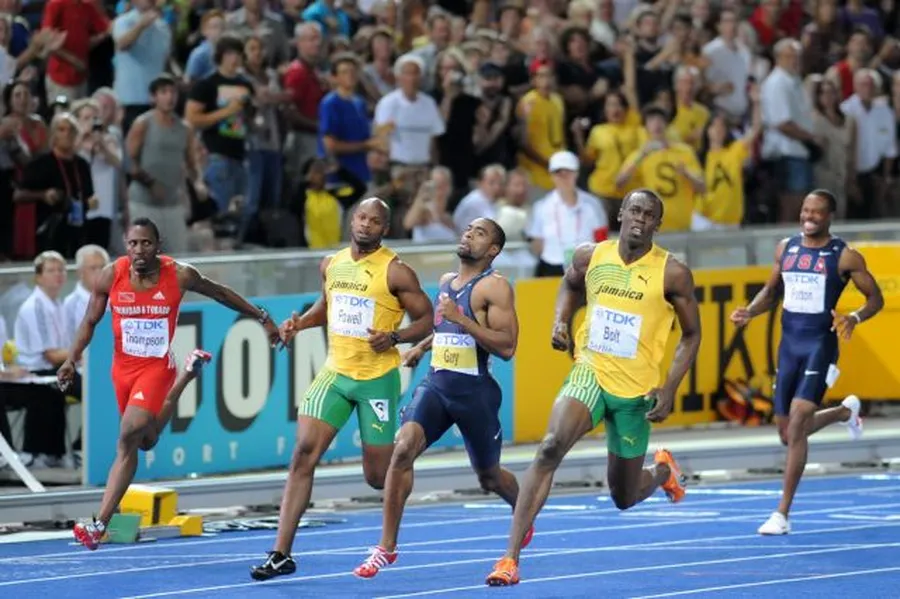
Current 100m World Records in 2026
Men's: 9.58 seconds – Usain Bolt (Jamaica), Berlin 2009.
Women's: 10.49 seconds – Florence Griffith-Joyner (USA), Indianapolis 1988.
These marks represent incredible human speed, with Bolt's standing unchallenged for over 16 years.
Quick Answer: 100m Sprint World Records History
The 100m has seen dramatic improvement since official records began in 1912. Men's times dropped from 10.6s to Usain Bolt's 9.58s. Women's records, starting in the 1920s, reached Florence Griffith-Joyner's still-standing 10.49s in 1988. Advances in training, track surfaces, starting blocks, and athlete physiology made these leaps possible.
Men's 100m World Record Progression
Official men's records started with Donald Lippincott's 10.6 seconds in 1912. The barrier of 10 seconds fell in 1968 when Jim Hines ran 9.95s at high altitude in Mexico City. American sprinters dominated for decades before Jamaican athletes took over in the 2000s.
| Time | Athlete | Date & Venue |
|---|---|---|
| 10.6 | Donald Lippincott (USA) | 1912, Stockholm Olympics |
| 9.95 | Jim Hines (USA) | 1968, Mexico City Olympics |
| 9.79 | Maurice Greene (USA) | 1999, Athens |
| 9.77 | Asafa Powell (JAM) | 2005 |
| 9.72 | Usain Bolt (JAM) | 2008, New York |
| 9.69 | Usain Bolt (JAM) | 2008, Beijing Olympics |
| 9.58 | Usain Bolt (JAM) | 2009, Berlin World Championships |
Bolt's three records in 2008-2009 represent one of the most explosive periods in sprint history.
Women's 100m World Record Progression
Women's records have a fascinating story too. Early marks were set in the 1920s, but the modern era belongs to Florence Griffith-Joyner. Her 10.49s from the 1988 US Olympic Trials remains the benchmark more than 37 years later.
| Time | Athlete | Year |
|---|---|---|
| 11.0s range | Early pioneers (various) | 1920s-1970s |
| 10.79 | Evelyn Ashford (USA) | 1984 |
| 10.49 | Florence Griffith-Joyner (USA) | 1988, Indianapolis |
Flo-Jo's performance at the trials, where she ran the three fastest times ever at that point, still sparks discussion today.
Key Milestones in 100m Sprint History
- 1912 — First official IAAF men's record: 10.6s by Donald Lippincott.
- 1936 — Jesse Owens' legendary performances, including world records and Olympic golds amid political tension.
- 1968 — Jim Hines breaks 10 seconds with 9.95s.
- 1988 — Florence Griffith-Joyner sets enduring 10.49s women's record.
- 2008-2009 — Usain Bolt rewrites the men's record book, reaching 9.58s.
Each era brought new stars and showed how small improvements in technique and technology add up over time.
What Drove the Record Improvements?
Better synthetic tracks, starting blocks, advanced training methods focusing on power and biomechanics, improved nutrition, and recovery science all played roles. Taller athletes like Bolt (1.96m) brought longer strides that changed what was thought possible. Wind-legal conditions and accurate electronic timing also refined what counts as official.
From hand timing to fully automatic systems in 1977, measurement accuracy improved dramatically.
The Bolt Era and Why the Record Still Stands in 2026
Usain Bolt's 9.58 seconds in Berlin combined raw talent, relaxed running style, and peak physical condition. He reached top speeds around 44.7 km/h. Even with modern spiked shoes and training, no one has seriously threatened this mark. Closest legal times remain in the 9.6x range. His record has now lasted longer than many previous ones combined.
FAQs – 100m Sprint World Records
What is the current men's 100m world record?
9.58 seconds by Usain Bolt (2009).
What is the women's 100m world record?
10.49 seconds by Florence Griffith-Joyner (1988).
Who was the first to break 10 seconds in the 100m?
Jim Hines in 1968 with 9.95 seconds.
Has anyone come close to Bolt's record recently?
Times in the low 9.7s have been run, but nothing has beaten 9.58 legally as of 2026.
Why do some records last decades?
They represent the absolute physical limit at that moment in time, combined with perfect conditions and extraordinary athletic talent.
Conclusion – The Enduring Magic of the 100m
The 100m sprint captures pure human speed like no other event. From Donald Lippincott in 1912 to the lightning of Usain Bolt and Florence Griffith-Joyner, each record tells a story of dedication, innovation, and the constant push against what seems possible. As we move through 2026, these marks continue to inspire new generations of sprinters chasing history on the track.
Related Athletics Resources
For more on building speed and strength, explore our guides to strength training for beginners or home workouts with no equipment. If you're interested in how the body adapts to training, check out general athletics topics.
Data Sources & Notes
Records drawn from World Athletics official progression lists, historical Olympic and World Championship results, and verified timelines. Times reflect IAAF/World Athletics ratified marks with automatic timing where applicable. Always check the latest official sources for any updates, as the sport continues to evolve.
For more sports content, visit our sports section.