
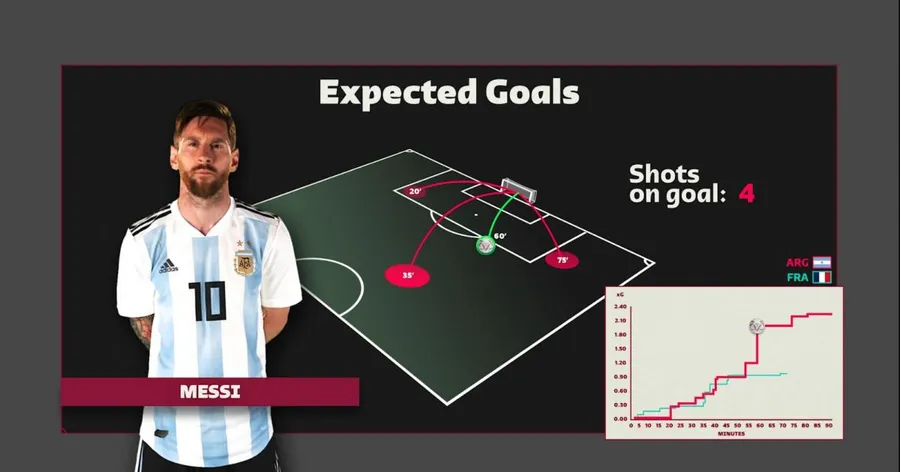
What Expected Goals (xG) Actually Tells Us
Expected Goals measures the quality of every scoring opportunity in a football match. Instead of just counting goals, it assigns each shot a probability (between 0 and 1) based on factors like distance from goal, angle, shot type, and how many defenders are nearby.
Quick Answer: What is xG in Football?
Expected Goals (xG) estimates how many goals a team "should" have scored based on the quality of chances created. A shot from 6 yards has high xG (~0.7-0.8), while a 30-yard shot has low xG (~0.05). It helps evaluate true performance beyond the final scoreline.
What is Expected Goals (xG) and Why It Matters
Traditional goal tallies can be misleading because of luck, brilliant goalkeeping, or poor finishing. xG removes much of that noise by focusing on chance quality. A team that creates 2.1 xG but scores only 1 goal is likely performing well and may improve their finishing over time.
Since its popularization in the mid-2010s, xG has become one of the most widely used advanced metrics in football analysis.
How Expected Goals is Calculated
Modern xG models use thousands of historical shots and machine learning to assign probabilities. Key factors include:
- Distance to goal and shooting angle
- Body part used (foot vs head)
- Type of assist (through ball, cross, etc.)
- Defensive pressure and number of defenders
- Shot location on the pitch
Different providers (Opta, StatsBomb, Understat) may have slightly different models, but the core principle remains the same.
Reading xG Visual Metrics and Charts
xG visualizations make the data easy to understand at a glance. Common charts include:
- xG Timeline — Shows how expected goals accumulated during the match.
- Shot Maps — Dots sized by xG value, colored by team.
- xG Difference — Compares total xG for both teams.
A team with many small dots spread across the box usually shows sustained pressure, while one or two large dots near the goal indicates high-quality chances from set pieces or counters.
Key Insights You Can Gain from xG Data
| Scenario | xG Insight | What It Suggests |
|---|---|---|
| High xG, low goals | Strong chance creation | Likely to score more in future games |
| Low xG, high goals | Overperformance | May regress toward average |
| xG difference of 1.5+ | Dominant performance | Team deserved to win clearly |
Practical Ways to Use xG for Match Analysis
- Compare a team's xG over the last 6-10 matches to spot improving or declining trends.
- Look at xG against stronger/weaker opponents to understand true strength.
- Check finishing efficiency (actual goals vs xG) for betting value opportunities.
- Use xG to evaluate whether a team is unlucky or genuinely struggling.
FAQs – Expected Goals (xG) in Football
What does a high xG mean?
It means the team created high-quality scoring chances and "deserved" more goals than they actually scored.
Is xG the same across all leagues?
Models are adjusted for league difficulty, but the basic principle remains consistent worldwide.
Can xG predict future matches?
Yes, better than goals alone. Teams that consistently create high xG tend to keep performing well.
What is a normal xG per game?
In top leagues like the Premier League, average xG per team per game is roughly 1.3–1.5.
Where can I find free xG data?
Understat and FBref offer excellent free xG statistics and visualizations for major leagues.
Conclusion – Why xG Has Changed Football Analysis
Expected Goals gives us a clearer, more objective view of what really happened in a match. It helps separate luck from skill and reveals which teams are truly performing well underneath the surface.
Whether you're a fan, analyst, or bettor, understanding xG adds depth to how you watch and evaluate football. The numbers don't lie — they just tell a more complete story than the scoreboard alone.
Related Football Resources
Combine xG with broader analysis by checking our guide on analyzing football matches for betting or explore general football content.
Data Sources & Notes
Concepts based on standard xG models from Opta, StatsBomb, Understat, and FBref (updated 2026). xG values can vary slightly between providers, but the overall insights remain consistent across major football analytics platforms.
For more football analytics and insights, visit our football section.