
What Is Electricity?
Electricity is the flow of electrons through a conductor like copper wire. When electrons move in the same direction, they create electric current that we use to power lights, refrigerators, phones, and almost every device in our homes.
Quick Answer: Basics of Electricity and Home Power
Electricity is generated at power plants by spinning turbines (using coal, gas, nuclear, hydro, wind, or solar). It travels long distances at high voltage, then is stepped down for safe home use. In most homes, 120V or 230V alternating current (AC) powers lights and appliances through wiring and circuit breakers.
What Is Electricity?
At its simplest, electricity is the movement of tiny negatively charged particles called electrons. In metals like copper, electrons can move freely. When a force (voltage) pushes them in one direction, we get electric current. This flow can be controlled and used to do useful work like lighting a bulb, heating water, or running a motor.
How Electricity Is Generated
Most electricity comes from power plants where a fuel source heats water to create steam. The steam spins a turbine connected to a generator. The generator uses magnets and coils of wire to turn mechanical motion into electrical energy. In 2025, about 60% of global electricity still comes from fossil fuels, while renewables like wind and solar are growing rapidly. A typical large coal or nuclear plant can produce over 1,000 megawatts – enough to power hundreds of thousands of homes.
From Power Plant to Your Home
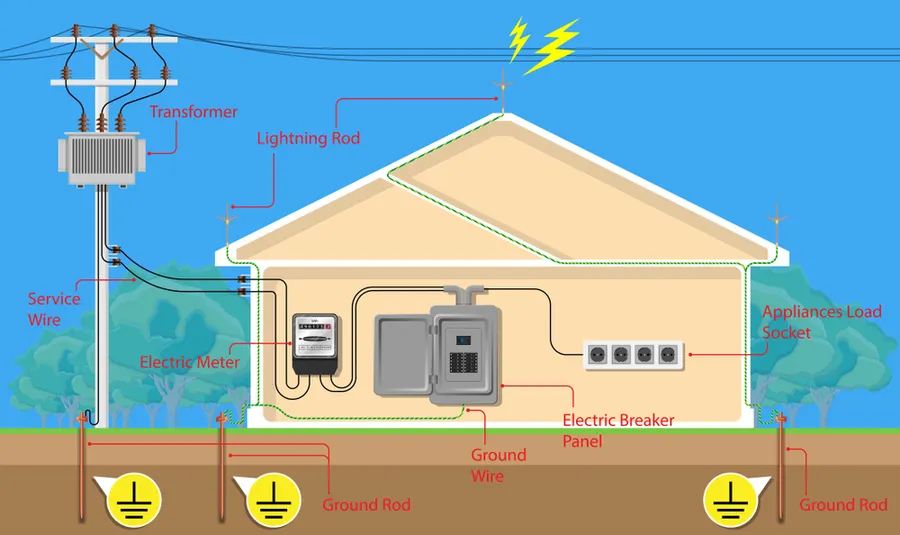
Electricity leaves the plant at very high voltage (often 110,000 to 765,000 volts) to reduce energy loss over long distances. It travels through transmission lines to substations near towns, where transformers step the voltage down. Finally, it reaches your neighborhood at safer levels and enters your home through the service drop or underground cable.
Voltage, Current, Resistance & Circuits
Voltage (measured in volts) is like water pressure. Current (amps) is the amount of flow. Resistance (ohms) is how much the wire or device slows the flow. A simple formula connects them: Voltage = Current × Resistance (Ohm’s Law). In homes, we usually use alternating current (AC) that changes direction 50 or 60 times per second. This makes it easier to transmit over long distances.
Electricity Basics at a Glance
| Term | What It Means | Home Example |
|---|---|---|
| Volt (V) | Electrical pressure | 120V or 230V outlets |
| Amp (A) | Amount of current | A phone charger uses ~1A |
| Watt (W) | Power used (V × A) | LED bulb: 8–10W |
How Electricity Powers Your Home
When you flip a light switch, you complete a circuit. Electricity flows from the breaker panel through wires to the bulb and back. Appliances like refrigerators, washing machines, and TVs all use the same principle but convert electrical energy into light, heat, motion, or sound. A typical home in many countries uses between 8,000 and 15,000 kilowatt-hours of electricity per year, depending on family size and climate.
Safety Tips for Home Electricity
- Never overload outlets or power strips – it can cause overheating and fires.
- Replace damaged cords immediately.
- Use ground-fault circuit interrupters (GFCIs) in bathrooms and kitchens.
- Keep water away from electrical devices.
- Have a qualified electrician handle any major wiring work.
FAQs – Basics of Electricity
What is the difference between AC and DC?
AC (alternating current) changes direction many times per second and is used in homes because it travels long distances efficiently. DC (direct current) flows in one direction and is used in batteries and electronics.
How much electricity does a typical home use?
In many countries, an average household consumes 8,000–15,000 kWh per year, or roughly 700–1,250 kWh per month.
Why do we need circuit breakers?
Circuit breakers automatically shut off power if too much current flows, preventing overheating and fires.
Conclusion – Understanding Electricity in Everyday Life
Electricity is one of the most important inventions in human history. From the power plant to the socket in your wall, a complex system of generation, transmission, and safe distribution brings this invisible energy into our homes every day. Understanding the basics helps you use electricity more efficiently, safely, and confidently.
To better understand the forces behind electricity and other natural phenomena, explore our guide on simple explanation of gravity and how it works or how the solar system works step by step.
Data Sources & References
Based on fundamental principles of physics, data from the U.S. Energy Information Administration, International Energy Agency, and standard electrical engineering resources.