
What Is Gravity?
Gravity is the natural force that pulls objects with mass toward one another. On Earth, it gives everything weight and keeps us, buildings, and oceans from floating away into space.
Quick Answer: Simple Explanation of Gravity
Gravity is the force of attraction between any two objects with mass. The more mass an object has and the closer it is to another object, the stronger the pull. On Earth, gravity pulls us downward at about 9.8 meters per second squared, giving us weight and keeping everything grounded.
Gravity in Everyday Life
You feel gravity every moment. When you drop a pen, it falls to the floor. When you jump, you come back down. Gravity holds the atmosphere around Earth so we can breathe, keeps rivers flowing downhill, and makes rain fall. Without it, life as we know it would not exist — objects would float freely, and planets would not stay in orbit.
Newton's Simple Law of Gravity
In 1687, Isaac Newton explained gravity as a force between any two masses. The force depends on how much mass the objects have and how far apart they are. The equation is F = G × (m1 × m2) / r², where G is the gravitational constant, m1 and m2 are the masses, and r is the distance between their centers. This law accurately predicts the motion of planets, moons, and falling objects on Earth.
Einstein's Revolutionary View of Gravity
Albert Einstein's general theory of relativity (1915) gave a deeper explanation. Gravity is not just a force — it is the curvature of spacetime caused by mass and energy. Massive objects like the Sun bend spacetime, and planets follow the curved paths, which we experience as gravitational pull. This theory explains phenomena Newton could not, such as the bending of light by gravity and the precise orbit of Mercury.
Gravity Facts at a Glance
| Aspect | Newton's View | Einstein's View |
|---|---|---|
| What gravity is | Force between masses | Curvature of spacetime |
| Strength on Earth | 9.8 m/s² acceleration | Same measured effect |
| Explains orbits | Very well | More precisely |
Gravity in the Solar System and Beyond
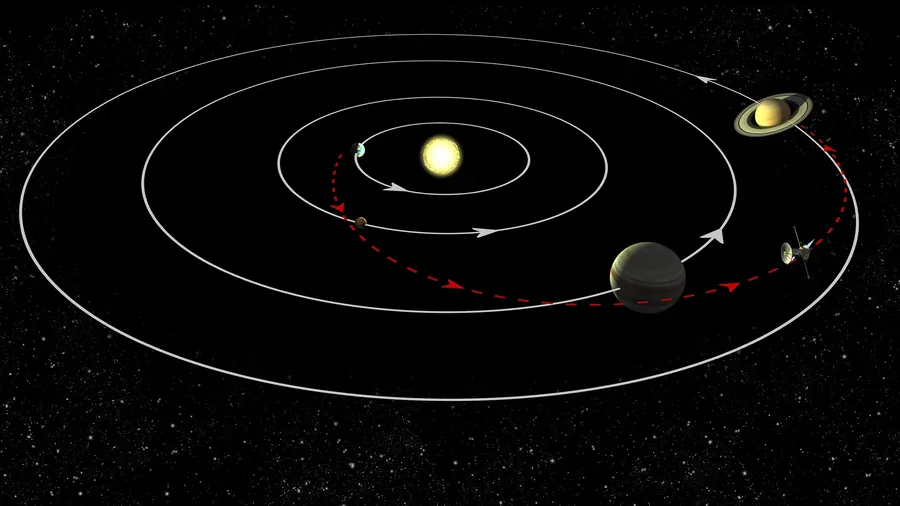
Gravity keeps the Moon orbiting Earth and Earth orbiting the Sun at about 150 million kilometers away. The Sun's enormous mass creates strong gravity that holds all planets in their paths. On the Moon, gravity is only about 1/6th as strong as on Earth — that's why astronauts could jump higher and objects fell more slowly. In the universe, gravity shapes galaxies, forms stars, and even creates black holes where the pull is so strong that not even light can escape.
Common Questions About Gravity Answered Simply
Why do objects fall at the same speed in a vacuum? Gravity pulls all objects equally regardless of mass, so without air resistance they accelerate at the same rate (9.8 m/s² near Earth's surface). Why is gravity weaker on the Moon? The Moon has much less mass than Earth, so its gravitational pull is weaker. Can gravity be turned off? No — gravity is a fundamental force present wherever there is mass or energy.
Fun Ways to Experience and Understand Gravity
Drop different objects (feather and coin in a vacuum tube if possible) to see they fall at the same rate without air. Notice how your weight feels slightly less at the equator due to Earth's rotation. Observe the tides — caused by the Moon's gravity pulling on Earth's oceans. These simple observations help build intuition about this invisible but powerful force.
FAQs – Gravity Explained Simply
What causes gravity?
Mass and energy curve spacetime according to Einstein, or attract each other according to Newton.
Is gravity the same everywhere?
No. It is stronger near larger masses and weaker farther away or on smaller bodies like the Moon.
Why don't we feel Earth's movement?
Gravity holds us firmly to the surface, and Earth's motion is smooth and constant.
Conclusion: Gravity – The Force That Shapes Our World
Gravity is the fundamental force that gives weight to objects, keeps planets in stable orbits, and shapes the universe on the largest scales. From Newton's apple to Einstein's spacetime, our understanding has grown, yet the everyday experience remains the same: it pulls us down and holds our world together. Understanding gravity helps us appreciate the delicate balance that makes life on Earth possible.
For more clear explanations of scientific concepts, explore how the human brain works explained simply or basics of genetics dna and inheritance explained.
Data Sources & References
Explanations drawn from Newton's Principia, Einstein's general relativity, NASA educational resources, and standard physics textbooks. Acceleration due to gravity is approximately 9.8 m/s² at Earth's surface.