
What Is a Black Hole?
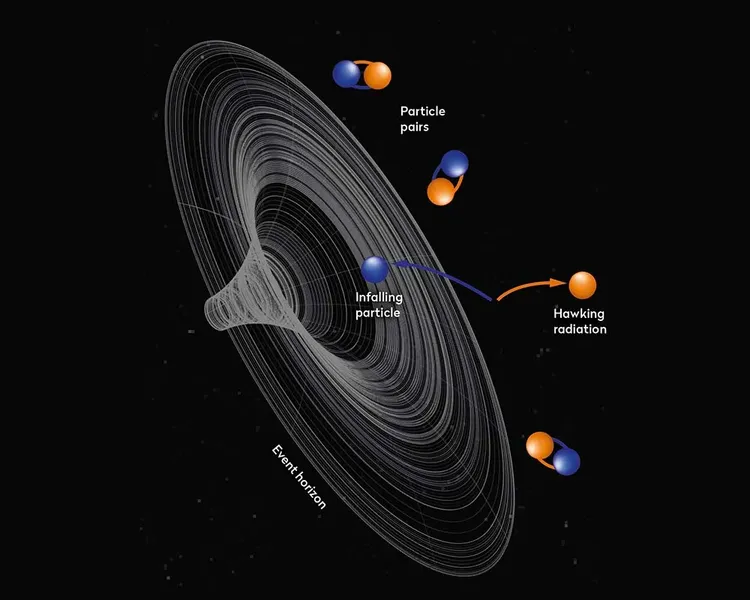
A black hole is a region in space where gravity is so extremely strong that nothing – not even light – can escape once it gets too close. The boundary around a black hole is called the event horizon. Anything that crosses it is trapped forever.
Quick Answer: Explanation of Black Holes for Beginners
Black holes form when massive stars collapse. Their gravity becomes so strong that they trap everything, including light. The point of no return is the event horizon. At the center is a singularity where current physics breaks down. Our Milky Way has a supermassive black hole called Sagittarius A* with about 4 million times the mass of the Sun.
How Black Holes Form
Most stellar black holes form when a star at least 8–20 times more massive than our Sun exhausts its nuclear fuel. Without the outward pressure from fusion, gravity wins and the star collapses in on itself in a supernova explosion. If the remaining core is massive enough (usually more than 3 times the mass of the Sun), it continues collapsing into a black hole.
The Event Horizon and Singularity
The event horizon is the invisible boundary around a black hole. Its size (Schwarzschild radius) depends on the black hole’s mass. For a black hole with the mass of the Sun, the event horizon would be about 3 kilometers across. Inside, at the very center, is the singularity – a point where density becomes infinite and our current understanding of physics no longer applies.
Types of Black Holes
Stellar black holes form from dying stars and typically have 5–100 times the mass of the Sun. Supermassive black holes, found at the centers of most galaxies, can have millions to billions of solar masses. Intermediate black holes (hundreds to thousands of solar masses) are rarer and harder to detect. Primordial black holes are hypothetical tiny ones that may have formed in the early universe.
Black Hole Facts at a Glance
| Type | Typical Mass | Example |
|---|---|---|
| Stellar | 5–100 solar masses | Cygnus X-1 |
| Supermassive | Millions to billions | Sagittarius A* (4 million solar masses) |
How Scientists Detect Black Holes
We cannot see black holes directly because they emit no light. Instead, astronomers look for their effects: stars orbiting an invisible massive object, X-rays from superheated gas falling in, or gravitational waves from colliding black holes (first detected in 2015). In 2019 and 2022, the Event Horizon Telescope captured the first direct images of the shadow of supermassive black holes in galaxies M87 and our own Milky Way.
Common Myths About Black Holes
Myth: Black holes suck in everything like a vacuum cleaner. Fact: They only pull strongly when you get very close; far away, their gravity is no different from any other object of the same mass. Myth: Black holes will eventually swallow the entire universe. Fact: They grow only by consuming nearby matter and merging with other black holes.
FAQs – Black Holes Explained Simply
What would happen if you fell into a black hole?
You would be stretched (spaghettified) by extreme tidal forces long before reaching the singularity.
Do black holes last forever?
They slowly evaporate through Hawking radiation over incredibly long timescales, but this effect is negligible for large black holes.
Is there a black hole near Earth?
The closest known is thousands of light-years away. Our nearest supermassive black hole is Sagittarius A* at the center of the Milky Way, about 26,000 light-years from Earth.
Conclusion: Black Holes – Nature’s Most Extreme Objects
Black holes are among the strangest and most fascinating predictions of Einstein’s general relativity. They push the limits of physics, challenge our understanding of space and time, and remind us how much we still have to discover about the universe. Even though they are invisible, their effects shape galaxies and help us understand the cosmos.
Continue exploring the universe with simple explanation of gravity and how it works or how the solar system works step by step.
Data Sources & References
Based on general relativity, observations from the Event Horizon Telescope, LIGO gravitational wave detections, and NASA/ESA educational resources.