
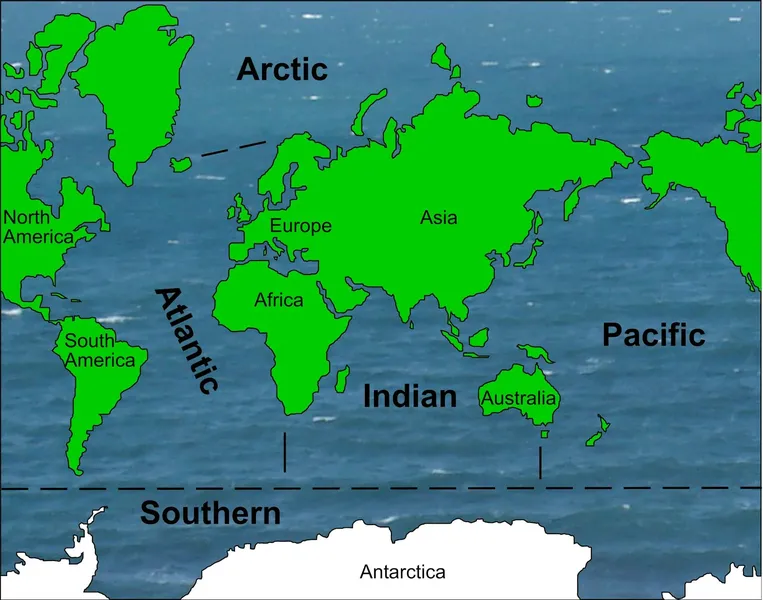
Quick Overview
The five oceans cover 71% of Earth's surface. The Pacific is by far the largest, while the Arctic is the smallest. Together they produce over half the oxygen we breathe and drive global weather patterns.
Quick Answer: Major Oceans of the World
There are five recognized oceans: Pacific (largest), Atlantic, Indian, Southern, and Arctic (smallest). They cover 361 million km², regulate temperature, produce oxygen, support marine life, and are essential for global trade and food supply.
Oceans Comparison Table
| Ocean | Area (million km²) | Avg. Depth (m) | Deepest Point |
|---|---|---|---|
| Pacific | 165.25 | 4,280 | Mariana Trench (10,984 m) |
| Atlantic | 106.46 | 3,646 | Puerto Rico Trench (8,376 m) |
| Indian | 73.56 | 3,741 | Java Trench (7,258 m) |
| Southern | 20.33 | 3,270 | South Sandwich Trench (7,236 m) |
| Arctic | 14.06 | 1,205 | Molloy Deep (5,550 m) |
Pacific Ocean – The Largest and Deepest
The Pacific Ocean covers more area than all the land on Earth combined. It contains the Mariana Trench, the deepest point on the planet at nearly 11 km deep. It is home to the Ring of Fire with most of the world's active volcanoes and plays a major role in global weather through phenomena like El Niño.
Atlantic Ocean – The Busy Ocean
The Atlantic separates the Old World from the New World. It is the second-largest ocean and the busiest for shipping and trade. The Mid-Atlantic Ridge is a massive underwater mountain range where new seafloor is continuously created.
Indian Ocean – The Warmest Ocean
The Indian Ocean is the only ocean named after a country. It is known for its warm waters and monsoon-driven currents. It borders many fast-growing economies and contains important oil shipping routes.
Why Oceans Are Vital to Life on Earth
- Produce more than 50% of the world's oxygen through phytoplankton
- Absorb huge amounts of carbon dioxide, helping regulate climate
- Provide food for billions of people through fisheries
- Drive global weather patterns and rainfall distribution
- Enable 90% of international trade through shipping routes
FAQs – Major Oceans of the World
Which ocean is the largest?
The Pacific Ocean, covering about 30% of Earth's surface.
Which ocean is the smallest?
The Arctic Ocean is the smallest by area.
How do oceans affect climate?
They absorb and distribute heat around the planet and influence weather patterns like monsoons and hurricanes.
Conclusion
The five major oceans are the lifeblood of our planet. They connect continents, sustain marine life, regulate climate, and support human economies. Protecting them is essential for the future of life on Earth.
Explore more geography topics: continents of the world, deserts of the world, countries with most islands, and countries with most natural resources.