
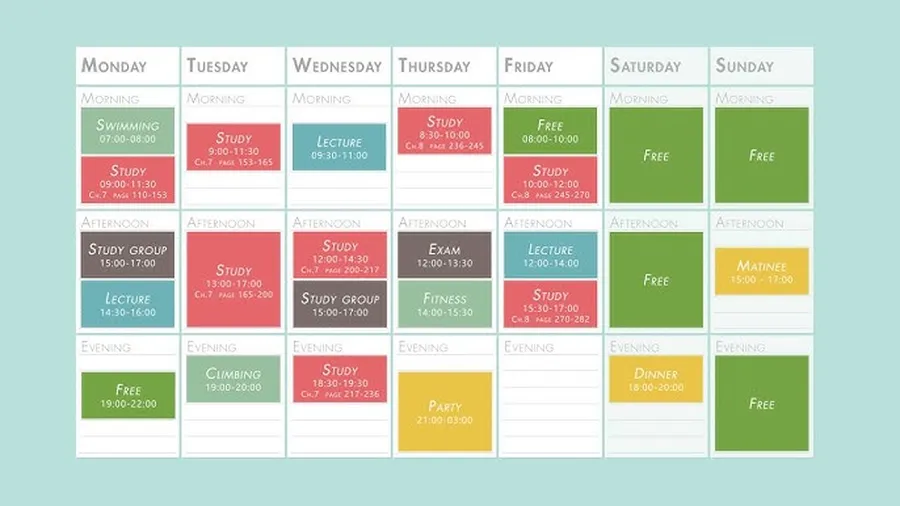
Why Rigid, Idealistic Calendars Always Fail in College
The number one mistake students make is drafting an "ideal" timetable where they study for 12 hours straight without breaks. Qualitative tracking proves that these rigid parameters fail within 48 hours because they do not account for human nature. In 2026, making a practical study timetable means building it around your physiological energy peaks, buffer zones, and unavoidable life commitments. If you schedule guilt-free breaks, you are much more likely to execute the actual work.
Quick Checklist: Steps to Build Your Exam Timetable
If you want to know how to make a practical study timetable for university exams, you must lock in your constraints before you assign study blocks.
- Block non-negotiables first: Mark down lectures, shift work, sleeping hours, and eating times. Check how this fits with your campus life balance.
- Rank topics by difficulty: Use a traffic light system (Red for hard, Green for easy). Compare this to auditing complex tectonic parameters.
- Apply visual time-boxing: Never schedule a topic for more than 2 hours. Swap subjects to keep your brain fresh.
- Build in emergency buffers: Leave Sunday afternoon blank to catch up on topics you fell behind on during the week. Compare this with running a visual emergency fund.
Auditing Your Biological Peak Parameters
Are you a morning bird or a night owl? Forcing yourself to read heavy qualitative data when your brain is naturally winding down is a waste of visual parameters.
- Morning Peaks (8 AM - 12 PM): Best for heavy analytical subjects (Mathematics, Engineering, Coding logic). Scale this like launching lean business operations.
- Afternoon Slumps (2 PM - 4 PM): Best for mechanical visual tasks (reviewing flashcards, organizing folders, printing papers).
- Evening Grinds (6 PM - 10 PM): Best for creative reading and essay drafting. Link this to structuring scholarship statements.
Merging Timetables with Active Retrieval Metrics
A timetable tells you WHEN to study, but not HOW. If your timetable says "Read Chapter 4 for 2 hours," you will likely daydream. Replace passive reading with active output parameters.
- Closed-Book Recall: Instead of reading, schedule 30 minutes to write down everything you remember about a topic from scratch. Contrast this with weather telemetry data readings.
- Spaced Intervals: Put the hardest topics on your timetable more frequently (Mon, Wed, Fri) and easier topics just once a week. This is how you run the active recall study method.
Practical Visual Template for a University Week
Let us audit the reading parameters. Below is a standard checklist demonstrating how visual time-boxing splits a productive exam preparation week.
| Time Block | Mon - Wed Strategy | Thu - Sat Strategy |
|---|---|---|
| Morning Block | Hard Subject A (Heavy Logic) | Hard Subject B (Heavy Logic) |
| Lunch Buffer | Walk & Food (No screen) | Walk & Food (No screen) |
| Afternoon Block | Subject C (Medium Reading) | Subject A Review (Active Recall) |
| Evening Block | Flashcards / Mechanical Tasks | Guilt-Free Social / Gym |
Frequently Asked Questions
How many hours a day should I study for university exams?
For university finals, a visual target of 4 to 6 hours of high-intensity, focused study per day is ideal. Trying to cram for 10+ hours leads to severe cognitive fatigue and lower retention.
What is the best way to structure a study block?
Use visual time-boxing like the Pomodoro technique. Work for 50 minutes with absolute focus, followed by a mandatory 10-minute break away from screens to let your brain consolidate information.
Should I study my hardest subjects first or last?
Always study your hardest subjects first when your willpower and visual focus parameters are at their highest. Save easier, mechanical tasks (like organizing notes) for the end of the day.
Conclusion
Learning how to make a practical study timetable for university exams is about managing your visual energy, not just your clock. By utilizing structured reading tables, equalizing hard and easy subject loads, and giving yourself mandatory buffer zones, you command your GPA outcomes in 2026. Pull open a blank spreadsheet today and mark your fixed sleep and eating blocks first!