
What Is Genetics?
Genetics is the study of how traits are passed from parents to children. At the center is DNA — the molecule that carries the instructions for building and running your body. Every human has about 20,000–25,000 genes made from DNA.
Quick Answer: Basics of Genetics, DNA and Inheritance
DNA is the instruction manual inside every cell. Genes are sections of DNA that code for specific traits. Humans have 23 pairs of chromosomes (46 total). You inherit half your DNA from your mother and half from your father, which is why you share traits with your family but are unique.
What Is DNA? The Molecule of Life
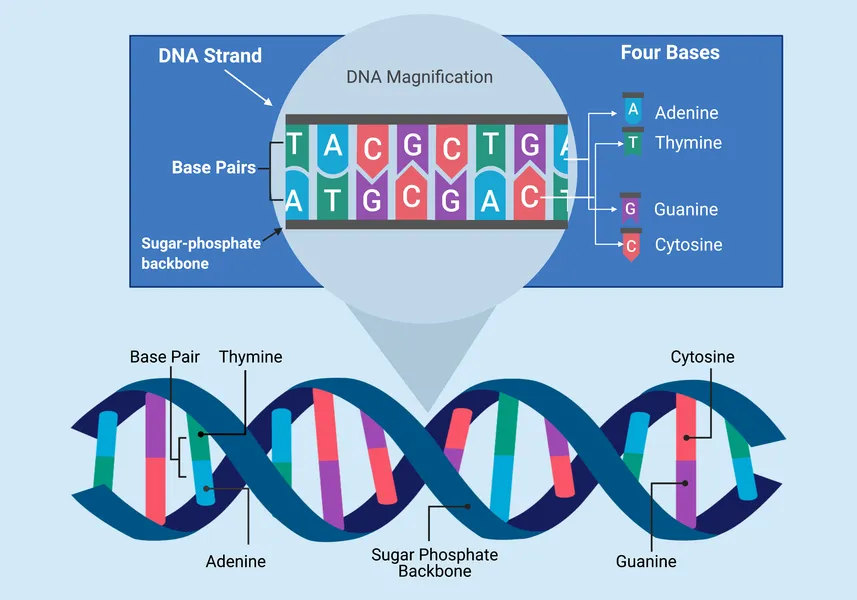
DNA stands for deoxyribonucleic acid. It looks like a twisted ladder (double helix) made of two strands connected by base pairs: adenine (A) pairs with thymine (T), and cytosine (C) pairs with guanine (G). The human genome contains about 3 billion of these base pairs. DNA is packed tightly into chromosomes inside the nucleus of nearly every cell in your body.
Genes and Chromosomes – Your Genetic Blueprint
A gene is a specific segment of DNA that contains instructions for making a protein or influencing a trait, such as eye color or height. Humans have roughly 20,000–25,000 genes. These genes are organized on 23 pairs of chromosomes — one set from each parent. Chromosomes are like filing cabinets that organize all your genetic information.
How Inheritance Works
During reproduction, each parent contributes 23 chromosomes (one from each pair) to the child. This means you get half your DNA from your mother and half from your father. Some traits follow simple patterns: if one parent passes a dominant gene for brown eyes and the other passes a recessive gene for blue eyes, the child will usually have brown eyes. However, most traits are influenced by multiple genes and environmental factors, making every person unique.
Key Genetics Facts at a Glance
| Concept | Simple Fact |
|---|---|
| DNA base pairs | About 3 billion in humans |
| Number of genes | 20,000–25,000 |
| Chromosomes | 46 (23 pairs) |
| Inheritance from parents | 50% from mother, 50% from father |
Dominant and Recessive Traits
Some genes are dominant — they show their effect even if only one copy is present. Others are recessive and need two copies to appear. For example, the gene for brown eyes is usually dominant over blue eyes. This explains why two brown-eyed parents can still have a blue-eyed child if both carry a hidden recessive gene.
Punnett Squares – Predicting Inheritance
Punnett squares are simple grids that help predict the probability of traits in offspring. For a single trait with dominant (B) and recessive (b) alleles, a heterozygous parent (Bb) crossed with another (Bb) has a 25% chance of a child with two recessive alleles (bb), 50% chance of heterozygous (Bb), and 25% chance of homozygous dominant (BB). This tool makes inheritance patterns easy to visualize.
Common Myths About Genetics
Myth: Genes determine everything about you. Reality: Environment and lifestyle play major roles too. Myth: You inherit exact traits from one parent. Reality: Most traits result from combinations of many genes plus outside influences. Understanding the real science helps separate facts from fiction.
FAQs – Basics of Genetics and DNA
What does DNA stand for?
Deoxyribonucleic acid — the molecule that carries genetic information.
Do identical twins have the same DNA?
Yes, they start with identical DNA, though small differences can appear later due to environment.
Can genetics predict diseases?
Some diseases have strong genetic links, but lifestyle and environment often influence whether the disease actually develops.
Conclusion: Understanding Your Genetic Blueprint
Genetics and DNA explain so much about who we are — from eye color and height to risk for certain conditions. Yet they are only part of the story. Environment, diet, exercise, and experiences also shape us. Learning the basics of genetics helps you appreciate the incredible complexity and uniqueness of every human being.
For more simple science explanations, see simple explanation of gravity and how it works or how the human brain works explained simply.
Data Sources & References
Based on standard biology textbooks, Human Genome Project data, and widely accepted scientific consensus (approximately 3 billion base pairs, 20,000–25,000 genes, 46 chromosomes).