
What Is the Scientific Method?
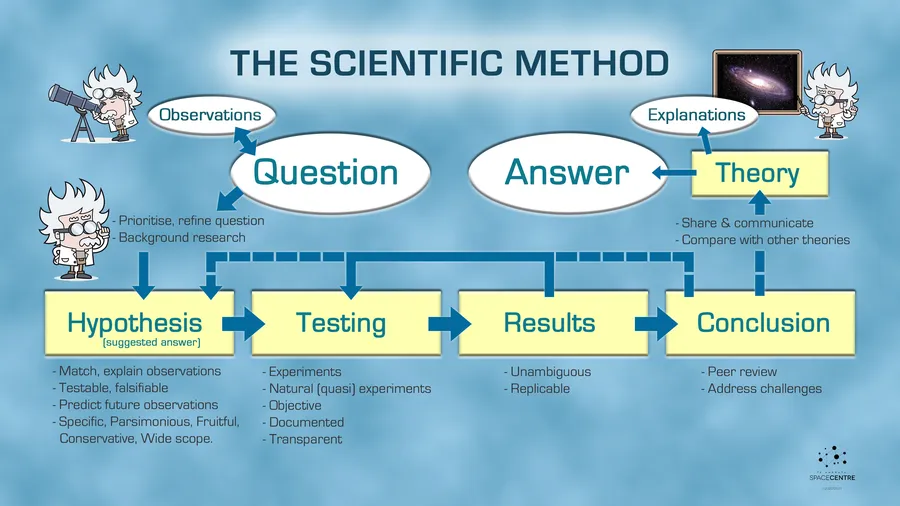
The scientific method is a logical, step-by-step process scientists use to ask questions about the world, test ideas, and find reliable answers. It helps remove guesswork and bias so we can understand how things really work.
Quick Answer: Scientific Method Steps
1. Observe something interesting. 2. Ask a clear question. 3. Make a testable hypothesis (educated guess). 4. Design a fair experiment. 5. Collect and analyze data. 6. Draw conclusions and share what you learned. The process can loop back if new questions arise.
Why the Scientific Method Matters for Students
Learning the scientific method helps you think clearly, solve problems, and make better decisions. It teaches you not to believe everything you hear but to test ideas with evidence. These skills are useful in every subject — from biology projects to figuring out why your phone battery drains fast.
Step 1: Make an Observation
Start by noticing something in the world around you. For example, you might observe that plants in the sunny part of the classroom grow faster than those in the shady corner. Good observations are detailed and use your senses or simple tools.
Step 2: Ask a Question
Turn your observation into a clear, answerable question. Instead of “Why do plants grow differently?”, ask “Does the amount of sunlight affect how fast bean plants grow?” Good questions are specific and can be tested.
Step 3: Form a Hypothesis
A hypothesis is an educated guess that can be tested. Example: “If bean plants receive more sunlight, then they will grow taller than plants with less sunlight.” It should be written as an “If… then…” statement and be falsifiable.
Step 4: Design and Conduct an Experiment
Plan a fair test that changes only one variable (the independent variable) while keeping others the same (controlled variables). In the plant example, use the same type of seeds, same soil, same amount of water, but different amounts of light. Repeat the test several times for reliability.
Step 5: Analyze the Data
Record your measurements carefully (height of plants each day, for example). Look for patterns. You can use tables, graphs, or simple averages. Does the data support your hypothesis or show something unexpected?
Step 6: Draw Conclusions and Communicate
Decide whether your hypothesis was supported, partially supported, or rejected. Even if the results are surprising, that’s valuable! Share your findings clearly so others can learn from or repeat your work.
Real Student-Friendly Examples
- Question: Does the temperature of water affect how fast sugar dissolves?
- Hypothesis: If water is warmer, then sugar will dissolve faster.
- Experiment: Test sugar in cold, room-temperature, and hot water while keeping the amount of sugar and stirring the same.
FAQs – Scientific Method for Students
Do scientists always follow the steps in order?
Not always. Science is flexible — new observations can send you back to earlier steps.
What if my experiment doesn’t support my hypothesis?
That’s okay! It still gives useful information. Scientists learn from unexpected results and often design new tests.
Can I use the scientific method at home?
Yes! Test which type of battery lasts longer in a toy, or which brand of paper towel absorbs more water.
Conclusion – Becoming a Better Thinker
The scientific method is more than a school exercise — it’s a powerful way to explore the world with curiosity and honesty. By asking good questions, testing ideas fairly, and learning from results, you build skills that help you in science class and in life.
Keep practicing with small experiments at home or school. For more on how scientists study our planet, check how climate change affects the environment globally or explore basics of electricity and how it powers homes.
Data Sources & References
Based on standard educational explanations from NASA, National Science Teaching Association, and introductory science textbooks used in schools worldwide.