
Quick Summary
The popular vote counts every citizen's individual ballot nationwide. The Electoral College is the actual mechanism that elects the president, with 538 electors allocated by state. A candidate needs 270 electoral votes to win, even if they lose the national popular vote.
Quick Answer: Electoral College vs Popular Vote
The popular vote is the total number of votes cast by American citizens across the country. The Electoral College is the constitutional system that determines the winner of the presidency through 538 state-based electors. A candidate can win the most individual votes (popular vote) but still lose the election if they fail to secure enough electoral votes.
How the Electoral College Actually Works
Each state gets a number of electors equal to its total congressional representation: the number of House members plus its two senators. Washington D.C. gets 3 electors. This gives a total of 538 electoral votes nationwide. Most states use a winner-take-all system — the candidate who wins the state's popular vote gets all of that state's electoral votes.
- Total electoral votes: 538
- Votes needed to win: 270
- States with winner-take-all: 48 + Washington D.C.
- States that split votes: Maine and Nebraska
Electors are usually pledged to their party's candidate, though "faithless electors" have occurred rarely in history.
What Is the Popular Vote?
The popular vote simply means the total number of votes cast by individual Americans for president across all 50 states and the District of Columbia. It reflects the direct will of the people as a single national total. However, it has no direct legal power to elect the president under the current system.
In recent close elections, the difference between the two candidates in the popular vote has sometimes reached millions while the Electoral College outcome went the other way.
Key Differences Between Electoral College and Popular Vote
| Aspect | Popular Vote | Electoral College |
|---|---|---|
| Definition | Total individual votes nationwide | State-based electors (538 total) |
| What determines winner | Highest total votes | At least 270 electoral votes |
| Legal power | Symbolic / advisory | Constitutional authority |
| Focus | National majority | State-by-state victories |
Historical Examples Where They Diverged
The popular vote and Electoral College have produced different winners five times in US history:
- 1824: Andrew Jackson won the popular vote but lost in the House of Representatives
- 1876: Rutherford B. Hayes lost the popular vote but won the presidency
- 1888: Benjamin Harrison lost the popular vote by about 100,000 votes
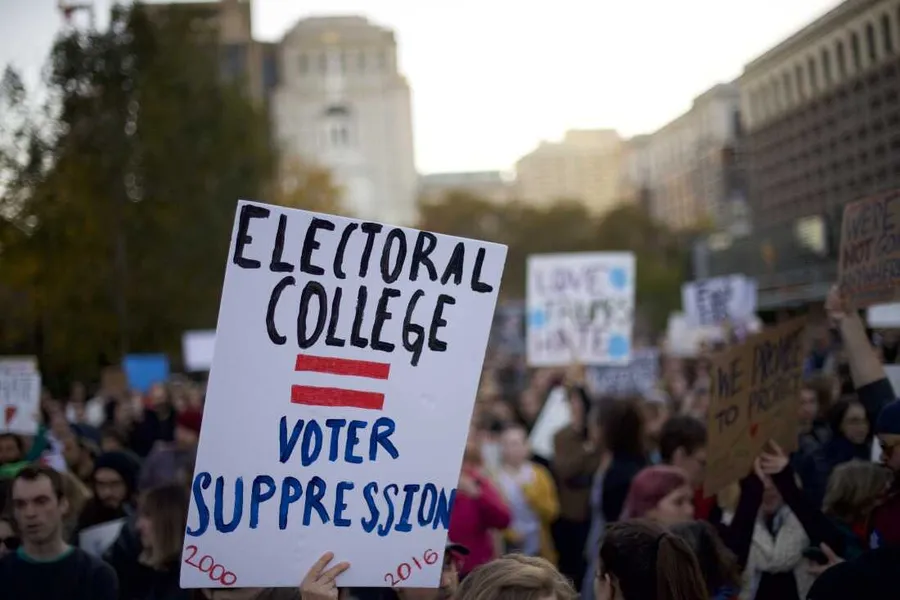
- 2000: Al Gore won the popular vote by over 500,000 votes but lost to George W. Bush
- 2016: Hillary Clinton won the popular vote by nearly 2.9 million votes but Donald Trump won the Electoral College
These cases highlight how winning key swing states can outweigh a national popular vote margin.
Why the United States Uses the Electoral College
The Founding Fathers designed this system as a compromise. They feared direct popular vote could lead to candidates ignoring smaller states or result in mob rule. The Electoral College gives every state a voice and forces candidates to build broad geographic coalitions rather than focusing only on high-population areas.
Smaller states receive a slight boost because every state gets at least three electors regardless of population size.
For more context on how power is distributed in governance systems, you might also explore our governance section.
Arguments For and Against the Electoral College
Supporters argue it protects federalism, prevents candidates from ignoring rural areas, and forces national campaigns.
Critics argue it can override the will of the majority, gives disproportionate power to swing states, and discourages voting in non-competitive states.
The debate remains one of the most discussed topics in American politics.
FAQs – Electoral College vs Popular Vote
Can a candidate win the presidency without winning the popular vote?
Yes. This has happened five times in US history, including the 2000 and 2016 elections.
How many electoral votes does a candidate need?
270 out of 538. This is a majority of the total electors.
Do all states award electoral votes the same way?
Almost all use winner-take-all, but Maine and Nebraska can split their votes by congressional district.
Has there ever been a tie in the Electoral College?
Yes, most notably in 1800, which was resolved by the House of Representatives.
Could the system ever change to popular vote?
It would require a constitutional amendment, which is a high bar. Some states have joined the National Popular Vote Interstate Compact to effectively award electors to the national popular vote winner.
Conclusion
The Electoral College and popular vote serve different purposes in the American system. While the popular vote reflects the direct voice of the people, the Electoral College remains the constitutional method for choosing the president. Understanding both helps explain why election nights can produce surprising results and why campaigns focus heavily on swing states.
The system was designed with careful compromises in mind, balancing population size with geographic representation. Whether you support keeping it or changing it, knowing how it actually works is essential for informed civic participation.
For more on US and global politics, visit our politics section.
Data Sources & References
Information based on the US Constitution, National Archives and Records Administration (NARA), Federal Election Commission data, and historical election records. Examples from 2000 and 2016 use official certified vote totals.
For more election-related explanations and governance topics, explore our elections section .