
Power Shared or Power Centralized?
The way a country organizes power between its central government and regional units fundamentally shapes how it is governed. Federal and unitary systems represent two very different answers to this question, each with distinct advantages and challenges.
Quick Answer: Federal vs Unitary Government Systems
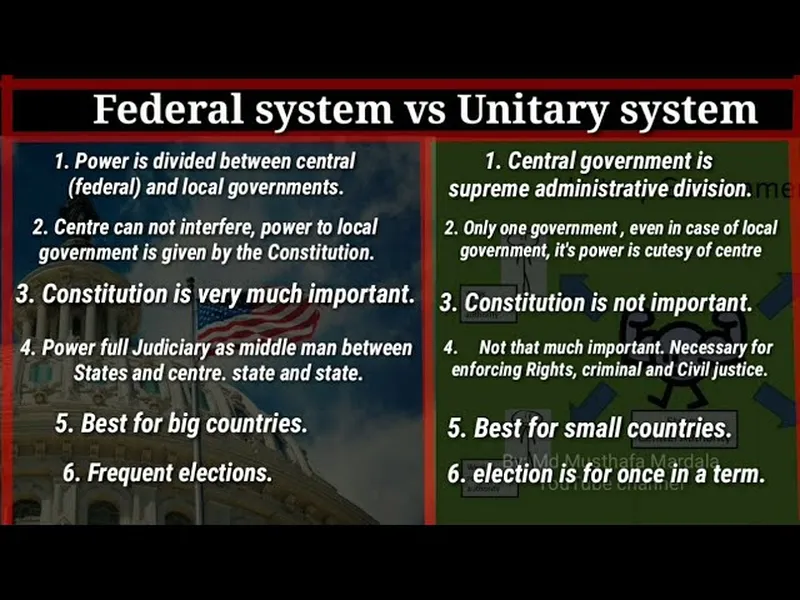
Federal systems divide sovereignty between a central government and regional states or provinces, each with constitutionally protected powers. Unitary systems concentrate sovereignty at the national level, with regions exercising only powers delegated by the center. Federal suits large, diverse countries; unitary enables faster, more uniform decision-making.
Definitions and Core Differences
In a federal system, both the central government and the regional governments derive their authority directly from the constitution. Neither can unilaterally abolish the other. In a unitary system, the central government holds all sovereign power and can create, alter, or abolish regional governments at will.
How Federal Government Systems Work
Federalism allows regions (called states, provinces, or cantons) to handle local matters such as education, policing, and health care, while the central government manages national issues like defense, foreign policy, and currency. This division reduces conflict in diverse societies and brings government closer to the people.
How Unitary Government Systems Work
In unitary states, the national government makes all major decisions. Regional or local governments exist mainly for administrative convenience and can be restructured or given more/less power whenever the center decides. This structure promotes national unity and consistent policies across the country.
Federal vs Unitary: Side-by-Side Comparison
| Aspect | Federal System | Unitary System |
|---|---|---|
| Power Distribution | Divided between center and regions | Concentrated at the center |
| Regional Autonomy | High (constitutionally protected) | Low (delegated only) |
| Best For | Large, diverse countries | Smaller or more homogeneous countries |
| Examples | USA, India, Germany, Canada | UK, France, Japan, China |
Advantages and Disadvantages
Federal systems promote innovation through policy experimentation at the regional level and accommodate cultural or linguistic differences. However, they can suffer from duplication of services and coordination challenges.
Unitary systems allow quicker national responses and more uniform standards. The downside is that they may ignore local needs and concentrate too much power, increasing the risk of authoritarianism.
Real-World Examples
The United States is the classic federal example, with powerful states that can set their own laws on issues like education and gun control. India uses federalism to manage its enormous linguistic and cultural diversity. On the unitary side, France maintains strong central control from Paris, while the United Kingdom has recently devolved some powers to Scotland, Wales, and Northern Ireland but remains fundamentally unitary.
Which System Works Better?
Neither system is universally superior. Federalism tends to suit large, diverse nations better, while unitary systems often work well for smaller or more homogeneous countries. Many nations today use hybrid approaches, combining elements of both to balance unity with local responsiveness.
FAQs – Federal vs Unitary Government Systems
Can a unitary country become federal?
Yes, through constitutional changes, as seen in some devolution processes or new constitutions.
Is federalism more democratic?
Not necessarily. Both systems can be democratic if they include free elections, rule of law, and protection of rights.
Do federal systems cost more to run?
Yes, because of duplicated bureaucracies and multiple layers of government.
Conclusion: Choosing the Right System for a Nation
The choice between federal and unitary systems is one of the most important decisions any country makes. It affects how responsive government is to citizens, how well it manages diversity, and how effectively it can act in times of crisis. Understanding these differences helps citizens better evaluate their own political systems and advocate for improvements.
Related reading: types of government systems explained democracy vs monarchy, how checks and balances work in government, and role of parliament in law making process.
Data Sources & References
Comparative politics textbooks, constitutional documents of various countries, World Bank governance indicators, and academic studies on federalism and decentralization.