
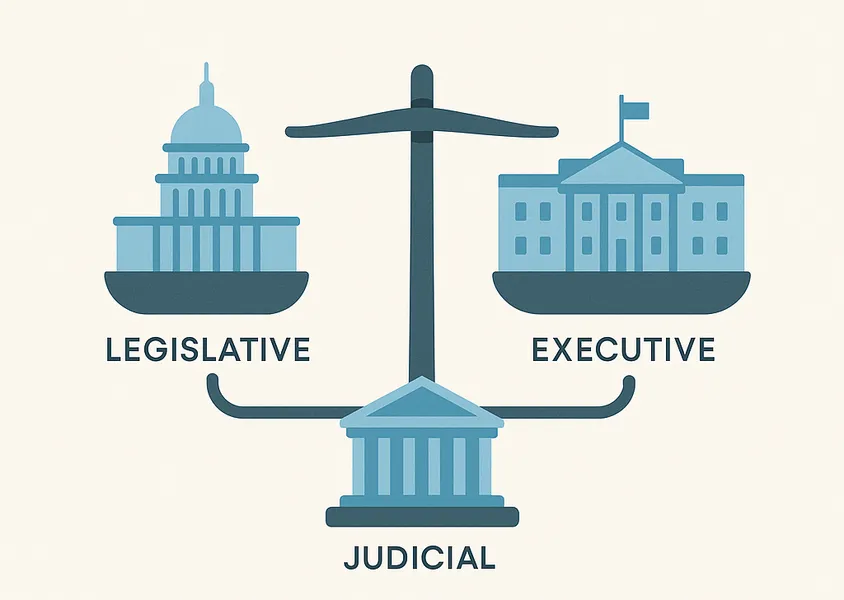
Power Divided to Protect Freedom
No single person or branch should hold unlimited power. Checks and balances divide authority among the legislative, executive, and judicial branches so they watch and limit each other. This system, inspired by thinkers like Montesquieu, remains one of the most effective safeguards against tyranny in modern democracies.
Quick Answer: How Checks and Balances Work in Government
Checks and balances divide government power among three branches: legislature makes laws, executive enforces them, and judiciary interprets them. Each branch has tools to limit the others — veto power, judicial review, impeachment, confirmation of appointments, and control of budgets. This prevents any one branch from becoming too powerful and protects citizens' rights.
The Core Principle of Separation of Powers
The idea is simple but powerful: power must be separated and distributed so that ambition counters ambition. When one branch tries to overreach, the others push back. This creates friction by design, forcing negotiation, compromise, and accountability.
Legislative Checks on the Executive and Judiciary
Parliament or Congress can override a presidential veto (usually with a supermajority), control government spending through the budget, impeach and remove officials, and confirm or reject appointments to courts and key executive positions. These tools give the people's representatives strong oversight.
Executive Checks on the Legislature and Judiciary
The president or prime minister can veto bills, issue executive orders (within limits), pardon individuals, and appoint judges or other officials (subject to legislative approval). In many systems, the executive also commands the military and conducts foreign policy with some legislative oversight.
Judicial Checks on the Other Branches
Courts can declare laws or executive actions unconstitutional through judicial review. Independent judges protect rights and ensure government actions stay within constitutional boundaries. This power is especially important when the other two branches collude or overreach.
Real-World Examples of Checks and Balances
- United States: Congress can impeach the president; the president can veto bills; the Supreme Court can strike down laws.
- United Kingdom: Parliament is sovereign but courts interpret laws and the House of Lords provides scrutiny; the monarch gives formal assent.
- India: The Supreme Court has struck down constitutional amendments and executive orders, maintaining strong judicial review.
Challenges and Limitations of Checks and Balances
The system can lead to gridlock when branches are controlled by opposing parties. Sometimes one branch becomes dominant due to political polarization or weak institutions. In some countries, emergency powers temporarily suspend normal checks during crises.
Why Checks and Balances Remain Essential Today
In an era of strong executives and social media-driven politics, checks and balances protect against populism, corruption, and authoritarian tendencies. They force deliberation and protect minority rights even when majority opinion is strong.
FAQs – How Checks and Balances Work in Government
Do all countries have checks and balances?
Most democratic countries have some form, but the strength and design vary widely between presidential and parliamentary systems.
Can checks and balances slow down government action?
Yes, intentionally. The trade-off is slower decision-making in exchange for better, more accountable governance.
What happens when checks and balances fail?
One branch can dominate, leading to abuse of power, corruption, or erosion of democratic norms.
Conclusion: Checks and Balances Protect Democracy
Checks and balances are not perfect, but they remain one of humanity’s best inventions for limiting government power while enabling effective governance. By making each branch accountable to the others, the system encourages compromise, protects individual rights, and prevents the concentration of power that historically leads to tyranny.
Related reading: role of parliament in law making process, types of government systems explained democracy vs monarchy, and roles and responsibilities of a president explained.
Data Sources & References
Constitutional texts, comparative government studies, Federalist Papers, and modern analyses of democratic institutions.