
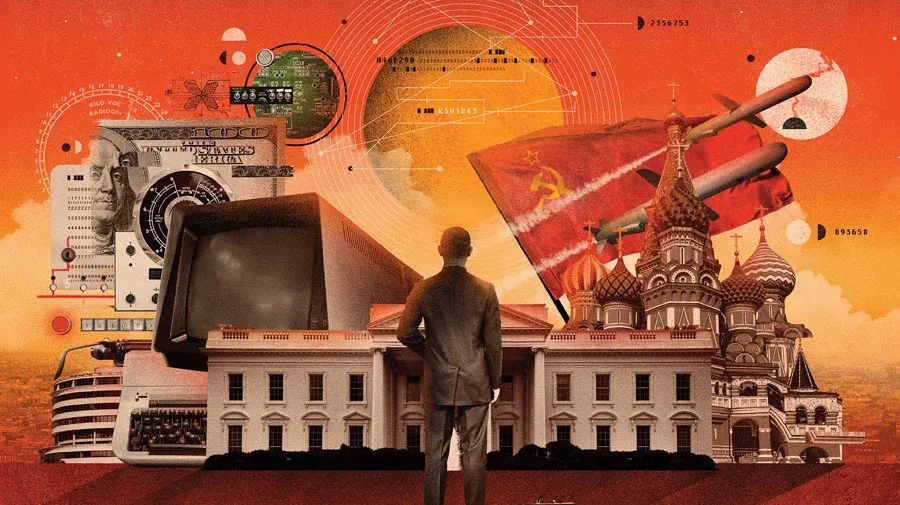
Why the Cold War Still Matters
Although the Soviet Union collapsed in 1991, the Cold War left deep marks on today’s world. Many current tensions — NATO expansion debates, nuclear deterrence strategies, proxy conflicts, and the renewed US-China-Russia rivalry — trace their roots directly back to the ideological and geopolitical struggle that defined the second half of the 20th century.
Quick Answer: Causes and Effects of the Cold War in Modern Politics
The Cold War was caused by ideological clash between capitalism and communism, mutual distrust after World War II, and Soviet expansion into Eastern Europe. Its effects included the creation of NATO and the Warsaw Pact, an arms race with over 70,000 nuclear warheads at peak, numerous proxy wars, and a divided world. Today, it continues to shape NATO’s role, nuclear deterrence, alliance systems, and the strategic rivalry between the US, China, and Russia.
Main Causes of the Cold War
The roots lie in the uneasy alliance during World War II. Once the common enemy (Nazi Germany) was defeated, deep ideological differences surfaced. The United States promoted democracy and free markets, while the Soviet Union sought to spread communism and secure a buffer zone in Eastern Europe. The power vacuum left by weakened European empires further intensified competition for global influence.
Key Events That Shaped the Cold War
- 1947 Truman Doctrine and Marshall Plan – US commitment to contain communism.
- 1949 Formation of NATO and Soviet atomic bomb test.
- 1950–1953 Korean War – First major proxy conflict.
- 1962 Cuban Missile Crisis – Closest the world came to nuclear war.
- 1979 Soviet invasion of Afghanistan – Major escalation in the late period.
Major Effects During the Cold War Era
The rivalry led to an unprecedented arms race. At its peak in the 1980s, the world had approximately 70,000 nuclear warheads. Europe was divided by the Iron Curtain. Dozens of proxy wars (Vietnam, Afghanistan, Angola) caused millions of deaths. The Space Race accelerated technological progress, while espionage and propaganda became central tools of statecraft.
Lasting Legacy in Modern Politics
NATO, originally created to counter the Soviet threat, has expanded to 32 members and remains central to European security. Nuclear deterrence doctrine still guides military strategy for major powers. Many current flashpoints — Ukraine, Taiwan, the Middle East — reflect patterns of proxy influence and ideological competition established during the Cold War. The division between Western liberal democracies and authoritarian-led states echoes the old East-West split.
Parallels with Today’s Great Power Competition
The current strategic competition between the United States and China shares many characteristics with the US-Soviet rivalry: technological race, alliance building, ideological narratives, and concerns about spheres of influence. Russia’s actions in Ukraine have revived Cold War-style bloc politics in Europe. However, today’s world is more economically interconnected, making full-scale confrontation more costly.
FAQs – Causes and Effects of Cold War in Modern Politics
Was the Cold War really “cold”?
It was cold in the sense of no direct military conflict between the US and USSR, but proxy wars caused millions of deaths worldwide.
Did the Cold War ever really end?
The bipolar ideological struggle ended in 1991, but many structures, doctrines, and rivalries it created continue to influence global politics.
How did the Cold War affect developing countries?
Many became battlegrounds for proxy conflicts, received massive military aid, and experienced long-term political instability as a result.
Conclusion – A Conflict Whose Shadow Still Lingers
The Cold War was more than a historical period — it created the institutions, strategies, and mindsets that still define much of international relations today. From NATO’s continued relevance to nuclear deterrence policies and the pattern of great power competition, its effects are deeply embedded in modern politics. Understanding its causes and consequences helps us better navigate today’s complex and multipolar world.
Related articles: global superpowers and their influence in world politics, how foreign policy shapes international relations, and what causes international conflicts between countries.
Data Sources & References
Historical records from the US State Department and Soviet archives, SIPRI arms data, analyses from the Council on Foreign Relations, Brookings Institution, and academic works on Cold War history and its contemporary legacy.